Phys 728, Spring 2012 Homework Problem Set #5
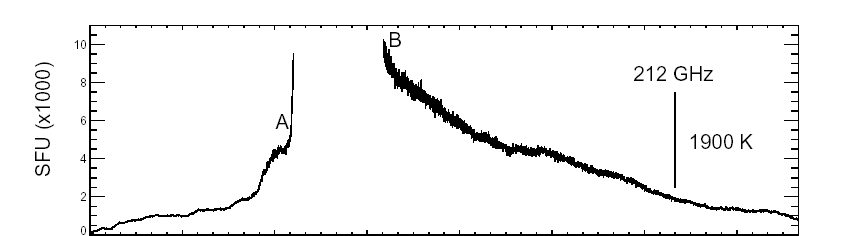
5.1. A paper claims to detect spikes from a solar flare, based on the plot shown below. Note the scale of solar flux units on the left, and the bar indicating the range corresponding to 1900 K in antenna temperature. Show that these two scales are not consistent by calculating how many solar flux units would correspond to a 1900 K antenna temperature, given the following information: Trx = 2000 K, antenna diameter 1.5 m, zenith sky opacity t = 0.58, elevation angle 48 degrees, antenna efficiency h = 0.6. What is the total atmospheric extinction at this elevation? What is the total flux density corresponding to 1900 K before correction for atmospheric extinction? After correction for extinction? By what factor is the range of SFU in the figure too large?
6.2 Given two sources of amplitude a1 = 10 and a2
= 5, and spatial position q1
= 12 arcsec and q2 = -6
arcsec, what is the resultant amplitude and phase, ar
and fr measured on a baseline
of fringe spacing 54 arcsec? If measured at 5 GHz, what projected
baseline length between the two antennas does this fringe spacing correspond
to? What is the corresponding value of u, in wavelengths,
assuming the baseline is entirely East-West?
6.3 Write a program (in IDL or MatLAB) to plot u,v coverage for the EOVSA array (latitude 37.23317 N), whose (E, N, U) antenna locations (in meters) are shown in the table below. Write the program to accept, as input parameters, the observing frequency, the source declination, and the hour angle range. Use your program to plot the u,v coverage for 10 GHz observing frequency, for (1) a source at declination d = 13o, and (2) a source at declination d = 0o. Both plots should cover an hour angle range -6h < h < +6h with 0.1 h resolution. In your plots, plot u on the horizontal axis, and v on the vertical axis, with (0,0) at the center of the plot, and use equal u and v scales ranging from -150 kl to 150 kl. Label the scales in kilowavelengths. Do not forget to plot both u,v points for a given baseline. Keep your program--you will be using a modified version of it in the following homework.
Antenna # |
E (m) |
N (m) |
U (m) |
1 |
187.86 |
71.74 |
1.04 |
2 |
196.15 |
75.14 |
1.03 |
3 |
175.11 |
77.39 |
1.04 |
4 |
197.96 |
50.25 |
1.04 |
5 |
194.66 |
108.86 |
1.13 |
6 |
147.42 |
35.91 |
1.04 |
7 |
266.83 |
67.10 |
1.23 |
| 8 |
98.95 |
169.34 |
1.32 |
| 9 |
20.35 |
-218.49 |
0.93 |
| 10 |
167.43 |
280.78 |
1.66 |
| 11 |
-442.00 |
-138.59 |
-0.25 |
| 12 |
640.22 |
-355.82 |
0.95 |
| 13 |
-329.06 |
861.82 |
3.01 |
| 14 |
-631.00 |
-184.00 |
25.84 |
| 15 |
-213.00 |
-187.00 |
25.22 |