Course Outline: OPSE 402
Spring 2015
Instructor:
Andrei Sirenko
476 Tiernan
sirenko@njit.edu,
tel: (973) 596-5342
Office hours: Tuesday
and Thursday 11:30 am – 1:00 pm or by appointment
Course Materials:
Instructor handouts. References
books on reserve in Library. Lecture notes will be posted on the
web.
Recommended book: Hecht, Optics
Also consult the
Physical Review Style and Notation Guide at http://publish.aps.org/STYLE/ a copy
is available in the labs
· Learn about physical phenomena by performing quantitative measurements
· Gain experience with techniques and instrumentation used in modern physics laboratories in Academia and Industry
· Gain experience in solving problems, which occur in experimental measurements
· Learn basics of data acquisition, data analysis, data storage, and data presentation
for this course you will need a Lab Notebook with numbered pages
Note:
The
laboratory manual will be distributed in class or via the World Wide Web.
OPSE web address: web.njit.edu/~sirenko
LECTURE NOTES:
Lecture
1 LASERS
Lecture
2 SHG
Lecture
3 Raman
Scattering
OPSE Lab
Open Hours: OPSE
lab (642-4956) will be open on Fridays.1 pm – 4 pm or by appointment.
OPSE Lab
Teaching Assistant: tbd
Prerequisites:
Recommended: Math 222 (differential equations), OPSE 301.
Assignments: You are responsible for all
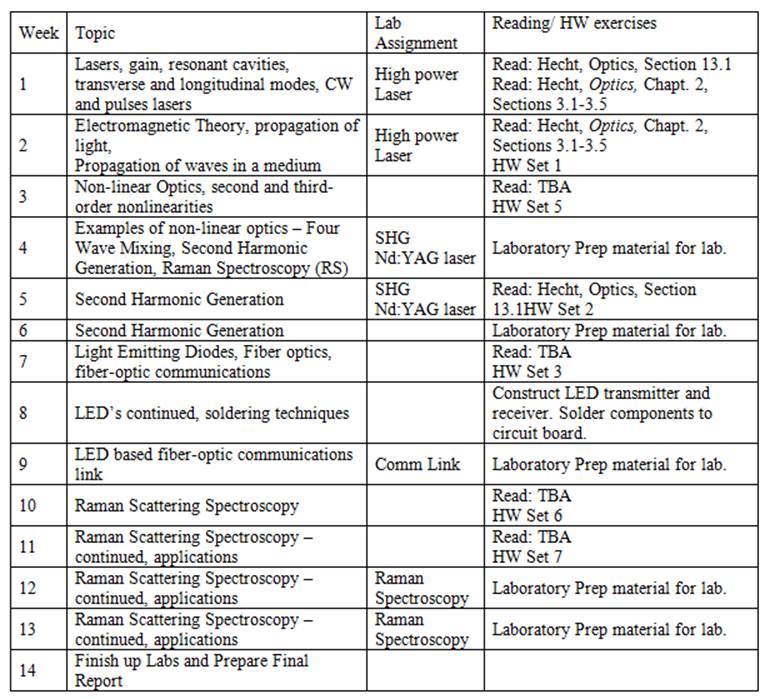
weekly reading and homework assignments listed in this outline. The reading should be completed BEFORE class
each week. Homework assignments must be
turned in according to the schedule listed in the outline. Homework assignments
may be turned in up to 1 week late with a penalty of 1 full grade (ie. A becomes a B, B becomes a C).
Each student must turn in individual Homework assignments. No group submissions
will be accepted.
During
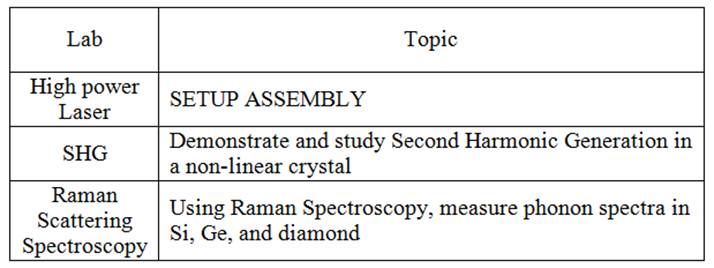
the course, you will complete 3 laboratory assignments. The lab reports are due
as indicated in the outline (nominally due 2 weeks after each experiment is
completed). Laboratory reports may be turned in up to 1 week late with a
penalty of 1 full grade (ie. A becomes a B, B becomes a C). Each student must turn in an individual
laboratory report. No group laboratory reports will be accepted.
Groups
and Working Together: You will typically work with one (maybe two) partners for
these experiments. You are encouraged to help each other with homework and
laboratory assignments. It is expected (although not required) that lab groups
will present the same raw data in their laboratory reports. However, each
student must submit an individual laboratory report with their own analysis,
graphs, and discussion. DO NOT CUT AND PASTE your laboratory reports from other
students’ work.
Attendance: It is expected that you will
attend every class. Since some of the equipment requires special safety
practices, do NOT miss scheduled laboratory days. Some experiments (the Raman
Scattering experiments) need to be scheduled in advance and may be scheduled
outside of our usual class time. Please be PROMPT and do not miss your assigned
times. If you anticipate an absence, please let your lab partners and your
instructor know immediately.
Exams: No written examinations will be
given. Instead a Final Oral Report will be presented during the week of Final
Exams. The final oral report will be a formal presentation of one of the experiments
performed during the semester. Each student must present an individual
laboratory oral report. No group reports will be accepted.
Grades:
Final Oral presentation will count as 1/4 of grade. Homework assignments will count as ¼
of your grade. The lab reports will collectively count as ½ of your
final grade. Grades of below 50% are failing (F).
•
There will be no food or beverages allowed in the Lab.
• If equipment seems to be
malfunctioning, see the lab instructor or teaching assistant. You are not
permitted to repair electrical equipment yourself.
• If you have to move the equipment,
make sure it is unplugged.
• Lab manuals and equipment manuals may
be signed-out for copying, but must be returned immediately. Ask the staff for
instrument manuals.
• Damaged or lost manuals should be
reported to the staff for replacement.
• If you break something, report it to
the lab instructor immediately so that it may be fixed or replaced. Do not try
to fix it yourself without reporting it. If you break equipment while doing
something less than brilliant, do not be embarrassed to report it. You will not
lose points if you break something, but you will be in big trouble if you do
not report it. Reporting problems so that they can be corrected will gain you
psychological points with the staff.
• Clean up after your lab session; leave
the apparatus and work area in good condition for the next group.
• Return tools, support stands, rods,
brackets, etc. to proper place. If you don't know the proper place, ask.
• When you need a tool from a set (e.g.
set of wrenches), take the whole set, then return it
whole. It is easier to locate a whole set than one missing piece.
• Do not use sticky tape, glue, aluminum
foil, etc. in experiments; it never works. Use a proper, professional-level
method; ask the lab instructor if you want to find the proper method.
Lab
Reports:
• The report should be typed
double-spaced (12 point font), and should be 4-6 pages long for the short
experiments and 10 pages for the long one, excluding figures.
• While your experimental results may
not be publishable, your report should be of publishable quality.
• Writing style should follow that outlined
in "Style for students (and Others)" by J. Schall, or the American Physical Society (APS) standard
outlined in
http://www.aip.org/pubservs/style/4thed/toc.html
and/or
Reviews of Modern Physics Style Guide
The Lab Report should include the
following sections:
1. Title page with
•
Title of experiment
•
Author name
•
Date submitted
2. Abstract
with a short summary
of the main results. It should be a self-contained paragraph, which interprets
the findings and describes their significance. The length is about 5-10 lines.
3. Introduction
2 or 3
paragraphs with description of the point of the experiment, historical
overview, and a few references to recent scientific papers on the related
subject.
References can be obtained by literature search at
http://www.library.njit.edu/
4. Theory
This should describe the theory and
other background information relevant to your experiment, including all
relevant equations and derivations where necessary.
5. Experimental procedure
This section should by a general
description of the method you have followed, and should be complete and
relatively detailed. It may include schematics of the experimental setup.
However, it should not be an excruciating list of every small adjustment you
made. This section can be a summary of the procedures described in the various
manuals you will be consulting, but it should not be a literal transcription!
Just for future reference for this lab, put detailed procedures in an appendix
to your paper.
6. Experimental results
In this section, results are reported in
Tables and Figures, and the data and error analyses you have done are
described. Note that Figures and Tables need to be numbered, to have captions,
and to be introduced in the text (e.g. ``In Figure 4 and Table 2 the measured
voltage as a function of applied external magnetic field is presented.''). Data
in Figures and Tables should not duplicate each other.
7. Discussion
This is where you bring it all together.
You can restate your salient final results. You can comment on sources of
error, difficulties encountered, and suggest ways to improve the measurements
in the future.
8. Conclusions
should not repeat the
Abstract
9. References
follow the APS style
when citing references
Please proofread your reports thoroughly
and check your calculations carefully before handing them in. Where appropriate
(but only where appropriate), perform fits to your data and report the fit
parameters with errors. Be as quantitative as possible in your analysis and
discussion. Please read what you write and be advised that the following will
result in lost points:
•
Typographical errors
•
Figures or tables without captions
•
Plots or tables without error bars
•
Misreported numbers of significant figures in any x±d
•
Miscalculated errors
•
Missing or faulty units
•
Egregiously bad English writing
•
Undefined parameters used in equations
•
Reports handed in late will be severely penalized
Schedule can change to accommodate new
experiments