
| home | | | cv & research | | | award & book | | | grants | | | teaching | | | students | | | contact |
| Quick Links |
|
» Highlight » IntegraL » EZ Search |
|
||||||||||||
 |
Digital Library Service Integration Grant (DLSI) |
|||||||||||
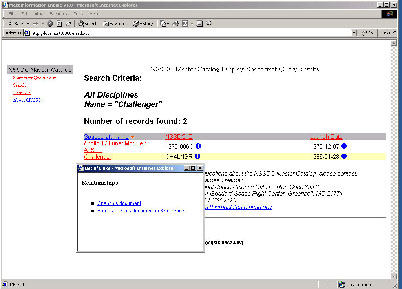 |
Screenshot of our current DLSI prototype, integrating two independent
digital library systems: NASA’s National Space Science Data Center
(NSSDC) Master Catalog and the Arizona Document Summarizer from the University
of Arizona. NSSDC users query the database from a form, returning the screen
above. DLSI added link anchors to elements it recognized: documents and
launch dates (indicated by the circled "i" in the 2nd and 3rd
columns). When the user selects a document anchor, DLSI generates the list
of links shown. The first will prompt the NSSDC system to display this
document. The second will prompt DLSI to pass the document to the external
AI Summarizer system. Clicking on a launch date generates
|
|||||||||||
|
a separate list of links to services relevant to that kind of element.
|
|||||||||||
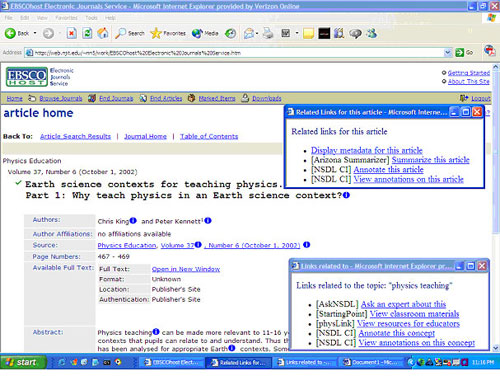
| The Digital Library Service Integration (DLSI) project provides a systematic lightweight approach for integrating digital library collections and services. When the user clicks on an item within a digital library collection or service, DLSI automatically generates a set of links to related information and relevant services. The set of links is customized using collaborative filtering techniques, matching the current user's navigation to the "click streams" of other users. | ||||||||||||
 |
||||||||||||
|
||||||||||||
|
|
IntLib Grant |
|||||||||||
|
||||||||||||
|
The IntLib Grant focuses on integrating the resources of public libraries primarily (and university libraries secondarily) together with digital libraries. It builds upon the DLSI project. We plan to integrate selected resources within:
|
|||||||||||
|
IntegraL Grant |
|||||||||||
The IntegraL Grant focuses on integrating specific resources of university libraries with those of the National Science Digital Library. It builds upon the DLSI project. We plan to integrate selected resources within:
The funding for the IntegraL and IntLib grants combined will enable us to develop two additional aspects that both projects will then use: a next generation collaborative filtering engine and next generation federated search. (IntLib is funding students and IntegraL is funding faculty to work together on these.) The IntegraL software will be freely available to university libraries and members of the National Science Digital Library to integrate their collections and services (if desired and when permissible, with those of our partners). |
||||||||||||
|
General Recommendation Engine Grant (GRE) |
|||||||||||
The General Recommendation Engine (GRE) project will develop the next generation of recommender systems, and apply these within the National Science Digital Library. GRE will supplement user's searches with sets of links that others have found useful. GRE will develop and combine three next generation approaches to recommendations: collaborative-filtering, content-based recommendations and knowledge-based recommendations to craft the best set of links to related information. For collection builders and service providers, this project will provide a ‘plug-and-play’ type of recommendation service that the NSDL system developers (collection builders) to make various levels of integration with GRE possible – from a simple ‘Similar Documents’ link to more sophisticated, fully enumerated recommendations. The figure below shows mock-up screens of simple and more sophisticated recommendations by GRE. |
||||||||||||
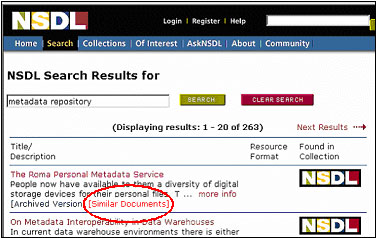 |
Mockup screen of the ‘Similar Documents’ feature: Clicking on the ‘Similar Documents’ link will display a list of documents similar to the current document (‘The Roma Personal Metadata Service’). |
|||||||||||
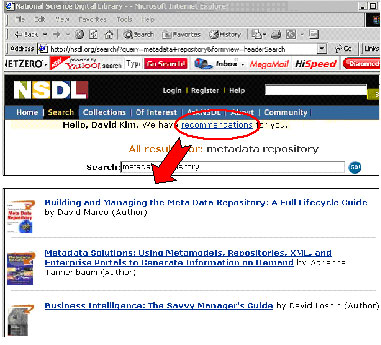 |
Mockup screen of the full recommendation feature This recommendation service requires more information such as user information, URLs that users visited (clickstreams), and actual document contents. This information will be sent to GRE as users use the system. The recommendation list can be displayed whenever a user logs in or only when the user requests it (as in the example shown). In the example, if the user clicks on the ‘recommendations’ link, a list of recommended documents will be displayed. |
|||||||||||
|
||||||||||||
Project Duration: Oct/2010 - Sept 2013 PI: Nancy Steffen-Fluhr, Co-PIs: Katia Passerini, Brook Wu Abstract: The NJIT ADVANCE IT project began in 2006 and has had a focus on examining the professional and research networks of women faculty in the STEM disciplines with the intent of using that knowledge to create distinct advantages for this target population. Among accomplishments reported in the first years of this project are: an interactive database of all NJIT faculty publications and use of statistical modeling and visual mapping to analyze gender patterns in network centrality. For the current project proposed, the NJIT ADVANCE IT program will develop career advancement tools as novel approaches to faculty mentoring. Intellectual Merit. In the current renewal proposal, this project proposes to implement two mentoring tools including a research partner finding tool and a faculty research network mapping tool. These tools are based on prior successes and represent intriguing and innovative approaches to establishing formal mentoring networks at institutions of higher education. Broader Impact. The New Jersey Institute of Technology ADVANCE IT project, because of its focus on network mapping, has the capacity to impact all women faculty in higher education. Reports of project findings are expected to be broadly disseminated using traditional means such as peer reviewed journal articles and national presentations. Additionally, the project PI has also initiated collaborations with other ADVANCE institutions who endeavor to use this tool as a mechanism for determining potential for advancement of women faculty at other institution types. |
||||||||||||